
 'Nlooni Halflings in Flintloque'
A Flintloque Background Article by Danny O'Hara
An extremely detailed breakdown of the Halfling peoples found in the Nuttull region of Afrique.
~
At the Battle of Barandiwina, the forces of Shaka baGinza and Merrysillkazi met in full blooded combat by the Limbopole River. Each numbered approximately five Stomps, and were ready for battle. As the sun rose above the felt, the two lines of magnificent Halfling warriors faced off and stamped out war dances. The earth shook, and clouds of red dust rose around the swirling, stamping throngs. Then the baGinza clashed spears on shields, and began a taunting war-song:
"We are Shakas boys - We are like locusts!
When we dance, the ground quakes!
We are come to eat the maTebetle!
Where can you hide, little goatherds!
We will put Merrysillykazi on a stick!"
The Mutterbeetles, who had marked time with their feet as the enemy song was sung, answered in similar fashion:
"We are the mountain-goats - Sons of Merrysillykazi!
Where we stand, there we fight!
No baGinza boy can match us!
We are Sons of the Rampaging Baby Elephant!"
Then, with the preliminaries over, they charged forwards towards each other and a darned good scrap!
~
Collecting a Nlooni Army
A good place to start is probably to build a Toe of warriors. This will make a good initial force, and can be expanded into a Foot, then Stride, and even Stomp (for the megalomaniac!). Personally, I think that a Foot is about the practical maximum. To recap from OITH No 9, the amaHalfling organisation is:
1 Stomp (800 warriors) = 4 Strides
1 Stride (200 warriors) = 2 Foots
1 Foot (100 warriors) = 5 Toes
1 Toe = 20 warriors
Obviously, the numbers above are approximations. I would advise a roll of 4D6 (i.e. 4-24) for the numbers in each Toe.
There is a new source for 28mm Pygmies! Kallistra have a lovely new range of these, and have an on-line catalogue with secure ordering. The range includes command figures, spear and knobkerrie-armed warriors, blow-pipe armed figures (which would be useful for "Ashanti" or other forest/jungle dwelling tribes of the deep Dark Continent!) and boar-riders (BaStoato horse?). The prices are quite nice as well...The Foundry "Darkest Africa" range includes pygmies, but I don't think much of them, personally. GW used to produce a range of Pygmy warriors, but these are sadly no-longer available.
For painting guides, try any books covering the Zulu or other colonial South African wars. A good start are the Osprey Men-At-Arms No. 57 "The Zulu War" (Angus McBride) and No. 212 "Queen Victoria's Enemies 1: Southern Africa" (Ian Knight & Richard Scollins). Virtually anything by Ian Knight is good for background and scenario ideas, if nothing else. (And the South African wars are interesting enough in themselves!).
Basically, I would advise painting your Halfling warriors black, then dry brushing or highlighting the flesh with a natural wood or "negro flesh" colour (experiment to find a technique which suits you). The regalia should be a mixture of white or black cow tail fringes (around legs and arms), kilts of monkey tails or hide, feather headresses of black, white and red feathers, and odd pieces of leopardskin. Obviously, the induna (officer) should have a generally better quality of equipment than the rank-and-file warriors. Shields (which are similar in pattern for all unit members) should be black, white or red-brown, with the amount of white indicating the experience of the unit (an entirely white shield represents a very tough unit indeed!). The strips of hide on the front surface should be of alternate colour to the main shield colour.
~
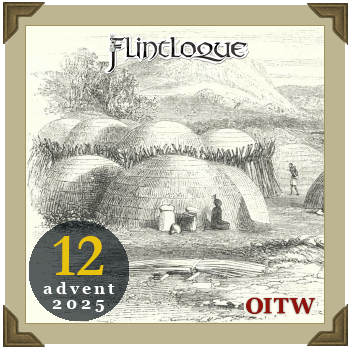
Building Nlooni Kraals
So how can these unusual Halfling dwellings be represented by modellers? With a bit of ingenuity it's surprisingly easy to produce acceptable Halfling homesteads. A very realistic hut can be made using a "ping-pong" (table-tennis) ball and cardboard. Cut the ping-pong ball in half along the seam, then use a thin strip of card, about 15mm wide, as the wall. Bend this into a circle, and glue the top inside the rim of one half of the ball. When dry, smear this with filler, scratching in the thatch when it begins to get tacky. After a bit of practice, it's possible to build up some very effective thatch patterns. More filler can be used to add on the rope retainers, or you can use thin strips of putty, or even cotton.
For larger huts, keep an eye out for any similar domes; you'd be surprised where they turn up. The kind of slot machines you find outside sweet-shops, dispensing trinkets in plastic domes, are a very good source, which provide both larger and smaller roofs. For the raised grain stores, simply sink garden twigs into filler on a card or wooden base, and add a platform from balsa. Make the store from a small dome, as you would a hut. Garden twigs, again, provide the basis of the stockade; if you put these on bases cut to rather general curves, you can use the same segments to build up larger or smaller circles, as required.
If you want to make a stone cattle-pen, loose chippings from a freshly re-surfaced road are ideal - but be sure to look both ways before you collect them, and then only look in the gutter!
Largely cadged from "Zulu Buildings for Wargames", by Ian Knight, in Military Modelling, July 1984
~
Webmaster's Notes
The above Flintloque background was originally published on Danny O'Hara's excellent Flintloque website, Weird Wars, way back in the 1990s.
The scenario was first published on Orcs in the Webbe on the 28th February 2008 with Danny’s kind permission. Sadly it was absent for several years due to a prior regeneration of the website not transferring everything over correctly. That wrong has now been righted and it returned in it's original form on the 12th December 2025 as the twelfth entry in that year's Advent Calendar and, of course, is part of Orcs in the Webbe's ongoing Flintloque Archive Project.
Danny passed away a few years ago now and I miss both him and his fantastic contributions to the world of Valon.
Any comments in maroon in the article above have been added by me either to provide additional information or clarity. I may also have made small changes to grammar and layout but have not marked these.
~